





By Ian Hart
Since 2013, Ian Hart has worked in the metal building industry helping customers build over 3,000 residential projects. Prior to that, his family ran a metal scrap yard for over 50 years in Kentucky. His experience within the metal industry helped him create Barndominium.org in 2020 to help connect residential customers with licensed builders.
Editor's note: Barndominium.org is an affiliate partner of Houseplans. The opinions stated here are the author's own. Barndominium costs may vary greatly, depending on whether you're building from a kit or not, the type of steel used, and much more. This article was updated in 2026 with current pricing.
The plans shown here may be designed with conventional wood framing. To specifically see plans with metal framing, check out these metal house plans.
If you are trying to decide between building a traditional house in 2026 and building a barndominium, price is one of the key factors you should consider. So, which is cheaper?
Here is the quick answer: on average, it is still cheaper to build a metal barndominium than a traditional wood-framed house in 2026 — but the gap is narrower than most of the internet will tell you. Expect to save somewhere in the range of 15 to 25 percent, not half.
Below, we provide a more detailed answer, giving you the typical cost ranges for both, an honest look at where the savings actually come from, and an overview of the factors that can push either type of home up or down in price.
Explore our collection of barndominium house plans here.
Traditional House Construction Pricing
The cost to build a traditional stick-built house in 2026 runs about $130 to $180 per square foot nationally for a conventional new home.
That figure covers the house itself. It does not include your land, and it does not include the custom and luxury end of the market, where budgets routinely exceed $400 per square foot once you add high-end finishes, complex rooflines, and expensive metropolitan labor.
One-Story Barndo Design

So when you see wildly different numbers quoted for stick-built homes, both are usually true — they are just describing different houses. A production or semi-custom build sits near the middle of that $130 to $180 band. A custom home with premium everything is a different conversation entirely.
Stick-built construction takes place mostly or entirely on-site.
Cost to Build a Barndominium Home
The cost to build a finished barndominium in 2026 ranges from about $65 to $160 per square foot.
Most projects land in the middle. Budget $80 to $120 per square foot for a standard finish nationally. The $130 to $160 range is where high-end builds sit — better cabinetry, upgraded flooring, larger window packages, more elaborate mechanical systems. For a typical 2,000 square foot home, that works out to a national average of roughly $230,000 for the complete project.
The structure alone costs considerably less. Metal barndominium kits run about $20 to $35 per square foot for materials only. Erected on your slab, the shell comes to roughly $30 to $50 per square foot.
That shell figure is the number that causes most of the confusion in this category, so it is worth sitting with for a moment.
Where the Savings Actually Come From
You will see claims online that barndominiums cost half of what a conventional house costs. They don't.
Here is why. The shell — the steel frame, the roof, the exterior panels, the erection labor — accounts for only about 30 to 40 percent of a finished barndominium's total cost. Everything else is the same work you would do in any house: plumbing, electrical, HVAC, drywall, flooring, cabinets, countertops, fixtures, and trim. A kitchen costs what a kitchen costs, whether it sits inside a steel frame or a stick-framed one.
Timeless Barndominium Design
 Timeless Barndominium Design - Front Exterior
So the barndominium advantage is real, but it is concentrated in one part of the build. Faster shell assembly and a more efficient structural package save you meaningful money. Then two things give some of it back:
• Insulation. A metal building needs a better insulation strategy than a wood-framed house, not a worse one. Closed-cell spray foam is the standard recommendation, and for a 2,000 square foot home that is typically a $15,000 to $30,000 line item. Skipping it is the single most common and most expensive mistake in this category.
• HVAC load. Open-concept barndominium layouts with tall ceilings move a lot of air. Systems are often sized larger than they would be in a comparable stick-built home, starting around $12,500 installed.
Net it out and you land at 15 to 25 percent savings in most markets. That is a genuinely good number. It is just not 50 percent, and any builder quoting you 50 percent is either leaving something out of the estimate or has not finished a project recently.
What This Looks Like by Size
Per-square-foot math is useful for comparison, but it is not linear. Kitchens, bathrooms, and mechanical systems cost roughly the same whether they sit in a 1,200 square foot home or a 3,000 square foot one, which is why smaller builds carry a higher per-foot cost. Here are typical 2026 figures for common sizes at a standard finish:
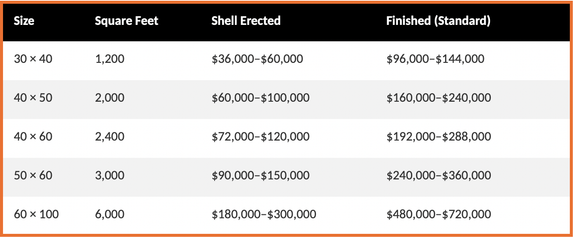
One caveat on the largest sizes. Homes in the 60×100 range are usually shop-houses, where only a portion of the footprint is finished as living space and the rest stays as workshop or storage. Real-world costs for those builds typically come in well below the fully finished figure.
Whatever size you land on, budget a 10 to 15 percent contingency. Custom builds find surprises.
Key Factors That Affect Cost
What accounts for why some homes fall at the top of their price range while others fall at the bottom? Why does one barndominium cost $80 per square foot while another runs $160?
Let's go over the factors that push costs up or down for barndos as well as traditional homes.
Size of home
The larger a house is, the higher its overall cost will be. It costs more to build a house measuring 60x100 feet than one measuring 40x60 feet.
Modest Barndo Plan
 Modest Barndo Plan - Front Exterior
That said, the larger the house, the lower the cost per square foot generally goes. So even though the overall cost is higher for a larger home, it is more cost-effective per square foot.
Floor plan
Your home's floor plan will impact what it costs. Simple floor plans with basic shapes are less expensive than elaborate ones. Every corner, bump-out, and roofline change adds material and labor.
Build process
Much of the cost difference between traditional stick-built homes and barndominiums built from metal building kits comes down to build process.
The traditional method involves transporting all of the materials to the building site and then doing every stage of construction there. During the process, the materials and the workers are exposed to the elements from start to finish, which can lead to delays or lost materials.
Building a barndominium with a metal building kit uses a prefabricated process instead. That means:
• More precision. Most prefabricated work takes place indoors in a factory, so there is greater control over both the environment and the manufacturing techniques. The result is better tolerances and more consistent quality.
• Less exposure. During the factory process, components are safe from harsh weather.
• Less material waste. Components are less likely to be damaged by the elements, and crews only order the materials actually needed. In traditional on-site construction, excess is typically ordered just in case — and you pay for it.
• Quicker build time. The shell of a barndominium often goes up in a matter of weeks rather than months. Note that this speeds up the structure, not the interior; finishing work runs on the same timeline as any other house.
• Smaller construction crew. Fewer personnel are needed for on-site assembly of prefab components than for framing a house from scratch, and less specialized equipment is required on-site.
Materials
Buying steel to build a barndo costs more per pound than buying lumber for a stick-built house, and steel pricing moves with the commodity market. If you can time your purchase to a softer steel market, that helps.
Simple Barndominium Design
 Simple Barndominium Design - Front Exterior
Despite the higher material cost, the overall cost of building a metal barndo still comes in below a comparable stick-built home.
Location
Where you build has a substantial effect on price, for barndos and traditional homes alike, and in 2026 it is one of the largest single variables.
• Regional labor and code. Missouri currently tracks near the bottom of the range at roughly $96 per square foot finished. California sits at the top, where seismic engineering, Title 24 energy compliance, and wildfire code requirements can add $9,000 to $15,000 before you have poured concrete. Northern states like Wisconsin carry their own premiums from deeper frost footings and higher snow load requirements.
• Building site. A complicated site that needs significant work before the structure can be placed will add to your costs, as will one that forces an unusual floor plan because the ground cannot be fully leveled. Site work commonly runs $20,000 to $50,000.
• Shipping. Moving materials or prefab components a shorter distance costs less than a longer one, and easy terrain costs less than mountains or water crossings.
Customization and finishes
The options you select for customizing and finishing a house have a significant effect on final pricing. This includes doors and windows, flooring, interior and exterior finishes, cabinetry, and insulation.
For reference, drywall installed typically runs $1.50 to $3.50 per square foot, and flooring ranges from $4 to $15 and up per square foot depending on what you choose. These are the line items where budgets most often drift.
Do Not Forget About Long Term Costs
One more thing to keep in mind when comparing a barndominium to a traditional home is your long term cost of ownership.
We have been focusing on upfront costs, but over the long haul you will maintain and repair your home, and you will pay utility bills.
On that front, metal has some real advantages:
• Steel is resistant to weather, fire, and pests. Over time it sees less wear and tear and is less likely to be damaged by extreme conditions, so routine repair and maintenance needs tend to be lower than for a comparable wood-framed house.
• The long-term durability of steel is outstanding compared to wood. It does not break down as quickly, so the structure stays in better condition longer.
On energy efficiency, be careful with the claims you read. A metal building is not inherently more efficient than a stick-built house — steel conducts heat, and an uninsulated or poorly insulated metal shell will cost you more to condition, not less. A properly insulated barndominium with closed-cell spray foam and a well-sized HVAC system performs very well. An under-insulated one does not. This is the place to spend the money.
Four-Bed Plan with Shop
 Four-Bed Plan with Shop - Front Exterior
We recommend steel as the main structural material for your barndo. It is lightweight, strong, and stands up to the elements admirably. You can discuss all of your options with your metal building company when you are designing your home.
The Bottom Line for 2026
Building a barndominium is still cheaper than building a traditional house in 2026. A finished barndo runs roughly $65 to $160 per square foot against $130 to $180 for a conventional new home, with custom builds on either side of that running higher.
The savings are real, but they are moderate and specific — roughly 15 to 25 percent in most markets, concentrated in the shell, and partially offset by the insulation and mechanical systems a metal building genuinely needs. Anyone promising you half off is selling something.
Split-Bedroom Design
 Split-Bedroom Design - Front Exterior
Go in with that expectation, budget your contingency, insulate properly, and line up your financing early, and a barndominium is one of the more cost-effective paths to a custom home available right now.
For current pricing by size and state, see the barndominium cost guide at barndominium.org here.