





 1-800-913-2350
 Many homeowners face this question when starting their dream home: Should I hire an architect?
Architects offer tailored designs, expert detailing, and a high level of customization – ideal for unique sites or complex wish lists. On the other hand, stock house plans provide ready-made designs that save both time and money, making them a faster and more affordable option for most homeowners.
These plans can often be customized to suit your needs and are typically created by professional residential designers or licensed architects. However, some states, such as Nevada, require all plans to be drawn by a Nevada-based architect, so it’s important to check local regulations before building.
We’ll break down the costs, timelines, flexibility, and risks of both paths – and share advice straight from home design experts.
Explore our best-selling house plans collection here.
Stock House Plans vs. Custom Designs – What’s the Difference?
If you’re building a new home, one of the first questions you’ll face is whether to choose a stock house plan or invest in a custom design.
Stock house plans are budget-friendly and often follow layouts that appeal to many buyers. A custom design is ideal if you have specific needs, a unique lot, or want a one-of-a-kind home tailored precisely to your lifestyle.
Stock House Plans – Pros, Cons, and Best Uses
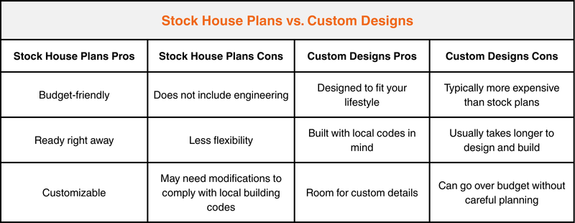
Stock house plans offer a quick, affordable way to get professional designs without starting from scratch. Here are some of the advantages and disadvantages of building a stock house plan:
Advantages:
Budget-friendly compared to custom designs
Ready right away
Tons of styles and sizes to explore
Customizable
Disadvantages:
Do not come with engineering, which may be required in your area
Less flexibility than a fully custom design
Can feel a bit generic
May need modifications or additional services to comply with local building codes
Best Uses:
Works well on standard lots
A solid choice if you want a reliable plan that’s been built before
Custom Home Designs – Pros, Cons, and Best Uses
Custom home designs give you the freedom to create a house that fits your lifestyle perfectly. Still, that level of personalization often comes with higher costs, longer timelines, and more decision-making along the way. Here are some advantages and disadvantages of custom home designs:
Advantages:
Layout planned around your lot, lifestyle, and daily routines
A local architect or designer will have local building codes and requirements in mind
Room to add specific or unusual characteristics you care about
Disadvantages:
Typically more expensive than stock plans
Longer design and construction timeline
A designer might not fully understand your vision, and you could end up spending a lot of time and money without getting the result you imagined
Risk of going over budget without careful planning
Best Uses:
Unique lots with irregular shapes, slopes, or restrictions
Homeowners with specific lifestyle needs or aesthetics
Can blend nicely with the landscape
Farmhouse Style Design
 Farmhouse Style Design - Front Exterior
Cost Comparison – Stock vs. Custom Plans
Stock Plan Price Ranges
The cost of a stock house plan is usually based on square footage and the type of plan package you buy, but is quite affordable relative to the scope of your project.
Most ready-to-build plans run between $1,000 and $2,000, though prices can shift based on the home’s size and style. Matt Clancy, our in-house home expert and director of sales, notes that “the average cost of a house plan is around $1,250.” The type of plan set changes the price, too. PDF files are often the most affordable and popular option, but you may choose to spend extra (twice as much or so) for CAD files, which give you detailed files for the greatest ease in modifying the plan.
Want to tweak something? Many small adjustments can be handled by your builder, but for larger changes, our modifications department is available. On average, plan modifications run between $900 and $1,500, plus the price of the PDF or CAD set.
With thousands of plans available, it’s easy to find a design that fits both your vision and your budget.
Two-Story Barndo Design
 Two-Story Barndo Design - Front Exterior
Custom Design Fees
How much are custom design fees? “This is a question we actually receive a lot from clients,” says Jake Bruton of Arrow Building, describing how architecture fees can vary widely.
Architectural firms that offer comprehensive services (covering everything from site and structural plans to interior drawings, construction documents, and permitting) typically charge around 5% to 10% of the total project budget, as noted by Bruton.
That’s a significant price difference. "Think on a 2.5 M home that is the difference between $125,000 or $250,000. So what does double the money get you? In some cases it gets you double the quality and double the information. In other cases it gets you absolutely nothing," he adds.
Bruton emphasizes that “the key to the entire equation is having a respected team in place that will provide good value at whatever the price point.” He also suggests clients “look for a firm that is willing to invoice hourly." With this model, you pay for the work directly, instead of the builder covering the costs and you paying a percentage of the total construction, like some architecture firms prefer.
As he puts it, “It doesn’t make much sense to me that if you choose substantially more expensive cladding, roofing, or countertops that the design firm makes more money when they did nothing different and their risk didn’t change. Hourly tends to be the most honest seeming in our market.”
Custom design costs depend on several factors, including:
Whom you hire: A licensed architect, residential designer, or design–build firm may all price differently, even for similar square footage.
Project complexity: Unique structural spans, steep or tricky sites, and lots of revisions usually mean higher fees.
Location and market: Design rates follow local construction and professional labor costs, so you will see higher fees in major metros than in lower-cost regions.
Service level: Full-service design costs more than basic plan sets or a stock plan.
Hidden Costs
Even well-planned builds can come with surprises – especially when it comes to engineering fees. Homes in coastal, mountain, or snowy areas often require additional structural work to withstand wind, earthquakes, or snow loads.
As our Director of Sales, Matt Clancy, explains, these stricter requirements can vary by region and sometimes add more to your total cost than you’d expect.
Other hidden costs include design changes, site prep, and meeting code requirements, all of which can quickly raise your total budget beyond the base construction cost.
Modest Modern Plan
 Modest Modern Plan - Front Exterior
Long-term Perspective
A stock house plan can be an easy way to save money upfront, but those savings don’t always last. If the layout doesn’t fit your lot, climate, or lifestyle, you might end up paying more down the road for changes, or for higher energy bills from a design that isn’t as efficient as it could be.
Choosing a stock house plan that’s right for you from the start is the best way to keep both your budget and your comfort in check.
When to Choose a Stock House Plan
You’ll want to secure your lot or piece of land before purchasing a stock house plan. The size, shape, and slope of your property will influence what kind of house you can build.
For instance, a single-story design typically needs more space than a two-story plan, while a narrow lot may call for a more compact footprint. Once the land is yours, you’ll know the right dimensions and restrictions to guide your home plan choice.
When a Custom Designer Is Worth the Investment
Hiring a custom designer is worth the investment when you want a house that truly fits your lifestyle instead of trying to make your lifestyle fit into a stock plan. While stock house plans are affordable and convenient, a custom designer can tailor every detail to your specific needs, lot conditions, and style preferences.
This option makes sense if your property has unique features (like slope, views, or narrow dimensions), if you need specialized spaces for work or hobbies, or if you simply want a one-of-a-kind home that reflects your personal vision.
Modern Style Design
 Modern Style Design - Front Exterior
Code Considerations
When building a home, whether using a stock house plan or a custom design, the rules and codes you need to follow really depend on your building location. Different areas have their own requirements for things like safety, setbacks, and permits. That’s why it’s important to check with your local building department early on, so you can make sure your plans fit what’s needed before you start building.
The stock house plans sold on Houseplans.com are generally designed to conform to the building codes from when and where the original house was designed. This is often a version of the International Residential Code.
Brad Graber of Custom Home Designs (and one of our trusted design partners), explains: “We design to the 2018 International Residential Code (IRC). Most states have adopted the IRC as their model building code, so that does help streamline things a bit. However, each state does take the liberty to review the code and then make their own changes to it. So in the end, it is not always a one-size-fits-all situation, but in most situations the plans will work in most states. Typically, a local builder may have to modify some of the details or construction methods during construction to make sure the local building codes are being met.”
Skipping permits might seem like a quick way to save time and money, but it can cause big problems down the road.
“If you’re working with a contractor who even hints at skipping this process, run. It’s always better to follow the proper procedures and ensure your project is fully compliant with local laws,” advises This Old House.
Stock Plan Licensing: Single-Use vs. Multi-Build
Single-Use License: This is the standard for most plans. A single-use license allows you to build the home from the purchased plans only once. If you purchase a PDF or CAD set, the plans can be adjusted for your needs or local building codes, but you can’t transfer, share, sell, or reuse the plans for another house. The plans may only be shared with your builder and others directly involved in your project.
Multi-Build License: A multi-build license is the opposite of a single-use license – it lets you use the same set of plans to build more than one home. With this license, you can construct multiple houses from the design without needing to purchase additional plan licenses each time. Some designers offer this option on their plans. Not sure about the plan you’re looking at? Just ask us.
Click here for more information.
Barndo Plan with Wraparound Porch
 Barndo Plan with Wraparound Porch - Front Exterior
Custom Design Advantage
A home designed with local rules in mind just fits right in. Custom home designs are crafted to comply with local building requirements from day one. This allows for smoother inspections, keeps construction moving, and (hopefully) less headaches.
Expert Advice
Curious what the pros think? This Q&A gathers expert insights and answers to some of the most common questions homeowners ask.
Which clients are best suited for stock house plans?
“I would say that almost all clients are certainly suitable candidates. Some clients find the exact plan they like, make the purchase, and proceed with the building process. Other clients find a plan they like, then engage with the original designer of that plan to make modifications to the plan to fit their specific needs. At Custom Home Designs, we work with a lot of clients in this capacity. We are able to offer a semi-custom design experience as we interact while performing the modifications with the customer after they have purchased our plan. Other clients may purchase the plan they like, take it to their local designer, and re-work the plans to fit their needs. This gives them the comfort of working with someone local to them while still giving the original designer of the plans credit and compensation for their great-looking design,” says Brad Graber.
What are the most common modifications homeowners request on stock plans?
Janet Hobbs, of Hobbs’ Ink and another one of our design partners, explains, “We do mostly slab on grade, so a lot of the time, requested modifications include adding a basement or crawlspace foundation for a part of the country where that is the norm. Probably the second most frequent one we see is expanding our already big garages. I’ve never had a client complain that their garage was too large! Third is usually kitchen or bath changes. Everyone wants to face the great room while they are working at their island, for instance.”
“Changes can be as simple as moving a door or a window, and as complex as a total re-design of the home. We can change roof lines, completely re-design layouts, change wall heights, just about anything you could imagine. Really, anything is on the table as to the type of change we can perform. If I were to boil it down to what type of change is most common, I would say that we adjust a lot of plans for square footage reasons...either bigger or smaller,” adds Graber.
Sam Morgan of Morgan Fine Homes, one of our valued design partners, notes, "My most common are right reading reverse and different foundation types. Beyond that they are typically simple things like making a room larger, adding or eliminating windows/doors, etc. The one thing I would recommend to people asking for modifications is to be VERY specific and include sketches to convey their message."
At what point does modifying a stock plan become as expensive as going custom?
“I tell everyone, change whatever you want at the edges, but leave the middle alone! If you want to enlarge your garage that sticks out in front or to the side, no big deal. Same with a family room that projects off the back,” says Hobbs.
She adds, “Changing a simple room with no plumbing or built-in cabinetry is easier than changing bathrooms or kitchens.”
“Basically, if the roofline has to change a lot or the main rooms of the home are going to change a lot, or you are rearranging major living spaces, you may as well start from scratch,” Hobbs explains.
How do building codes affect stock vs. custom plans?
According to Hobbs, “This is mostly a non-issue. Building codes have become pretty uniform around the country. It DOES affect structural sheets when you have to account for seismic or snow issues, but I always suggest the buyer get a local engineer to review and edit those sheets anyway, especially if they live in Wisconsin or on the West Coast. Most life safety codes, electrical and fire codes, all the normal things, are VERY similar from one jurisdiction to another. HOAs and subdivision requirements are another thing altogether, but building codes themselves usually don’t change much in my experience.”
What advice do you give to first-time home builders making this decision?
“It depends on their financial situation, but most first-time home builders have a budget as a big issue on their list, so stock is a good way to go,” explains Hobbs. “Make sure it makes sense with your property (don’t buy a tiny two story house for a big lot, get a nice, wide footprint that will look more appropriate there), but if it makes sense, a house that “stacks well” will save construction costs, a house (unlike most of mine) without too many angles and twists and turns and ins and outs will be less expensive to build, a two story house will be less expensive than a one story, sadly a courtyard house will be more expensive and so on.”
Hobbs also emphasizes the importance of site placement over the home’s design alone. “If money is not an issue (or even if it is), the MOST important thing is the land. You need to find a property where the logical spot for your home has the back of the house facing SOUTH. This may sound like it’s out of left field, but if you put even a beautiful custom home on your property and it is not oriented correctly to the sun, you will have a lousy experience. If you buy the simplest stock plan but orient it correctly, you will have a lovely home that makes you smile every day. So, again, make sure the back of the house will be facing south with a nice covered porch behind it, and you will be golden whether it’s a stock plan or a $100,000 set of plans from the best architect in town.”
Long-Term Value – Stock vs. Custom
Impact on Resale Value:
Stock house plans and custom designs each bring something to the table in terms of long-term value. Stock house plans can boost resale value because they’re designed to appeal to a wide range of buyers. They usually include layouts and features homebuyers are looking for, making the home easier to sell in many markets. Plus, these plans often reflect popular styles, which is a perk.
Custom home designs give you more freedom to create exactly what you want, which can make them especially appealing to some future buyers.
Cost Savings vs. Energy Efficiency:
When it comes to energy efficiency, custom sustainable designs often pay off. Many custom home builders are now adopting eco-friendly building practices.
According to NAHB, “Features like solar panels, water-saving appliances, insulation to improve heating efficiency and the use of renewable or recycled building materials are all popular techniques to improve a home’s efficiency.” They go on to add that “custom builders allow buyers to include a wide range of green products and give them the opportunity to weigh each cost and benefit to create a home that is stylish, comfortable, but also eco-friendly.”
Many of the same green upgrades can also be added later or incorporated into a stock plan with minor adjustments. This flexibility allows homeowners to pursue sustainability at their own pace, whether they're building from scratch or personalizing a predesigned layout.
With that said, we offer a variety of eco-friendly house plans and designs. Many of these stock house plans feature compact footprints, modest square footage, and passive solar potential. Best of all, energy-efficient homes come in all styles – from sleek modern layouts to classic Craftsman bungalows.
Explore our collection of eco-friendly house plans.
Stock house plans are a smart pick if you want something affordable, fast, and practical. But if you’re dreaming of a home that feels truly your own, custom plans are an investment in uniqueness, lifestyle, and long-term value. Ultimately, the best choice depends on your location, budget, and lifestyle.
Explore our houseplans FAQ page here.
Have questions about stock house plans? Contact us here.