



 1-800-913-2350
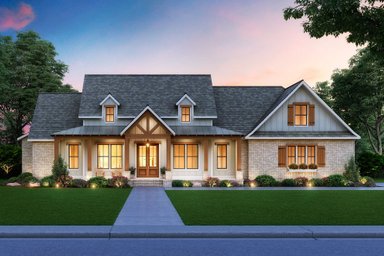
(NOTE: This post has been updated.) The word "bunk," meaning "sleeping berth," dates from 1758 and is probably a shortened form of the Scottish-derived word "bunker," in its sense as bench or seat, according to the Online Etymology Dictionary. It was first associated with beds on ships where space is always at a premium. Today's bunkroom can be any room with at least two narrow beds stacked against a wall in order to take up as little space as possible. It's a good solution for any home for a large family or where overflow guests need to be accommodated. Here are some examples, like Plan 443-13, at the top of this post, to get you thinking about how to organize your own bunkroom.
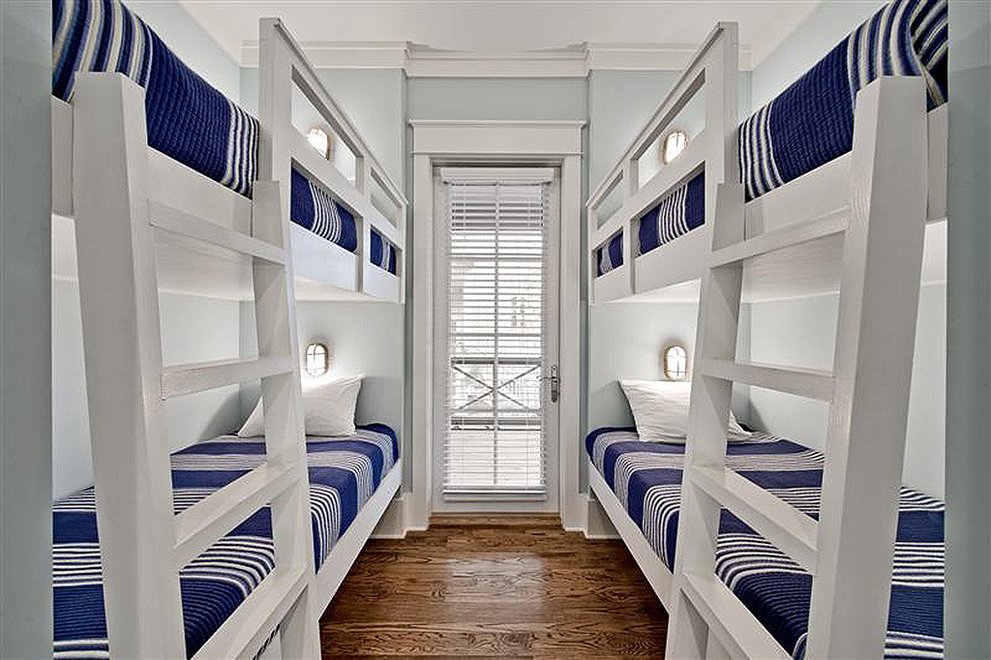
Plan 901-121, shown here, includes a bunkroom on the second floor. As you can see, it's an 11' 1 " by 11' 9"
room that's a little smaller than the adjacent Bedroom #2 but holds 5 beds. Now that's maximizing space!
Another way to treat bunks is to install them in alcoves, which creates a little more privacy while
still conserving square footage, as is done in Plan 901-120, shown here. Partially enclosed,
like berths on a train, each bunk bed alcove feels separate but still connected to the rest of the room; there's also a clever built-in reading shelf for each bed. Such an arrangement is especially appealing to children and is a great idea for people thinking of making their home more grandchild-friendly. This bunkroom doubles as a pass-through between another bedroom and the breezeway. Bunks can maximize
the space in a small bedroom, as shown here in Plan 928-4, where the beds form a niche for the built-in desk by the window.
Almost any flex space can become a bunkroom. Bunk beds come in a wide variety of sizes, materials, and configurations -- from twin over twin, to twin over a full-size bed. The beds can be situated parallel or perpendicular to each other. Some set-ups include a desk under the upper berth. IKEA's "Mydal" wood frame version, with a ladder that can be installed to left or right, is a typical example.
Some bunks even include a small closet built into the bed frame. The most innovative bunk bed
systems I have found are by Resource Furniture -- like their Kali Duo Board -- which stores
flat against the wall and includes a long shelf to uses as a temporary desk or counter when
closed. There'a soft safety rail for the top bunk. Another Resource design, the Lollisoft, takes a
minimalist modern approach and practically disappears when closed. When open, the streamlined bunks are very appealing -- if the room seems to sway gently and you hear the clickety-clack of wheels on rails you may already be asleep!
To browse a collection of plans with bunkrooms click here.
Plan 901-121, shown here, includes a bunkroom on the second floor. As you can see, it's an 11' 1 " by 11' 9"
room that's a little smaller than the adjacent Bedroom #2 but holds 5 beds. Now that's maximizing space!
Another way to treat bunks is to install them in alcoves, which creates a little more privacy while
still conserving square footage, as is done in Plan 901-120, shown here. Partially enclosed,
like berths on a train, each bunk bed alcove feels separate but still connected to the rest of the room; there's also a clever built-in reading shelf for each bed. Such an arrangement is especially appealing to children and is a great idea for people thinking of making their home more grandchild-friendly. This bunkroom doubles as a pass-through between another bedroom and the breezeway. Bunks can maximize
the space in a small bedroom, as shown here in Plan 928-4, where the beds form a niche for the built-in desk by the window.
Almost any flex space can become a bunkroom. Bunk beds come in a wide variety of sizes, materials, and configurations -- from twin over twin, to twin over a full-size bed. The beds can be situated parallel or perpendicular to each other. Some set-ups include a desk under the upper berth. IKEA's "Mydal" wood frame version, with a ladder that can be installed to left or right, is a typical example.
Some bunks even include a small closet built into the bed frame. The most innovative bunk bed
systems I have found are by Resource Furniture -- like their Kali Duo Board -- which stores
flat against the wall and includes a long shelf to uses as a temporary desk or counter when
closed. There'a soft safety rail for the top bunk. Another Resource design, the Lollisoft, takes a
minimalist modern approach and practically disappears when closed. When open, the streamlined bunks are very appealing -- if the room seems to sway gently and you hear the clickety-clack of wheels on rails you may already be asleep!
To browse a collection of plans with bunkrooms click here.