

 1-800-913-2350
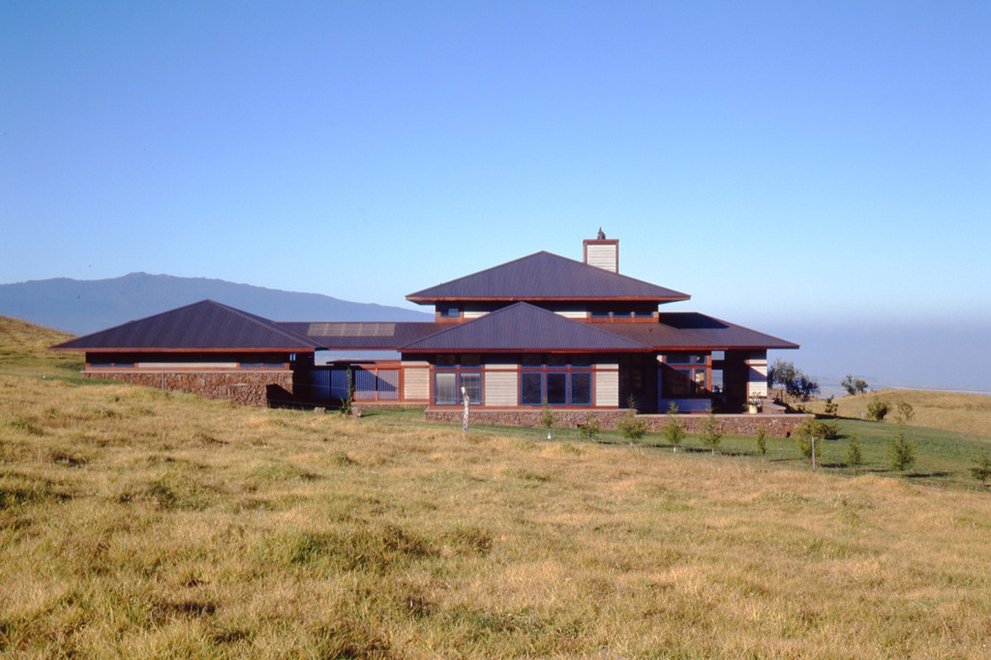
Let’s take a DNA strand from Henry Louis Gates’ fascinating PBS show Finding Your Roots and apply it to residential architecture and our latest design by architect Sarah Susanka, Plan 454-11. It was originally conceived for a dramatic view-oriented meadow on the Big Island of Hawaii, as shown here. The plan is a new addition to our Signature House Plans Collection and one of the descendants, if
you will, of Frank Lloyd Wright’s Prairie School houses (remember the film of the same name about a Hawaiian family, starring George
Clooney — genealogy is everywhere!!). At the Ward Willits house in Highland Park,Illinois, of 1901, for example, the hipped roofs and horizontal lines dominate, appearing to float over the deeply recessed eaves.
Susanka’s roofs also float; her design resembles a series of interlocking pavilions shaped to capture views in every direction. The Willits plan is a pinwheel shape; the rooms radiate from the hearth at the center, further accentuating the horizontality of the design and thereby expressing the lines of the Prairie itself, hence the style name. Sarah Susanka’s plan does something similar but within the overall constraint of the rectangle.
A generous central hearth also anchors her design while the island kitchen, living room, dining room, and bedroom wings reach toward terraces and the landscape beyond. A classic Susanka touch is to craft a room-within-a room for a sense of intimacy in a larger space, as she does in the breakfast alcove with its built in
seating and window walls. She uses dropped soffits — like abstract cornices — to support concealed lighting and vary ceiling heights, which is also something Wright did. Susanka’s use of wood to articulate structure
also recalls Japanesque design and this resonates with Wright and his lifelong interest in Japanese prints, not to mention his design of the Imperial Hotel in Tokyo from the early 1920s. It turns out he traveled to Japan for the first time in 1905, with guess who — Mr. and Mrs. Willits.
But you may ask, how does Prairie style relate to Hawaii? Well actually, there’s a logical connection, and it has to do with the hipped roof. The Hawaiian architect Charles Dickey is credited with developing a regional Hawaiian style of architecture through his use of the broadly sheltering hip roof. Architect Bertram Goodhue’s more elongated hip roof for the Honolulu Academy of Art of 1927 developed the form on a monumental scale. Though the Wrightian and Susankan roofs read more as separate geometric units that seem to levitate over their structures than the Hawaiian hips, the connection is there. I’d just call them calabash cousins — i.e. extended family — no saliva test required.
Susanka’s roofs also float; her design resembles a series of interlocking pavilions shaped to capture views in every direction. The Willits plan is a pinwheel shape; the rooms radiate from the hearth at the center, further accentuating the horizontality of the design and thereby expressing the lines of the Prairie itself, hence the style name. Sarah Susanka’s plan does something similar but within the overall constraint of the rectangle.
A generous central hearth also anchors her design while the island kitchen, living room, dining room, and bedroom wings reach toward terraces and the landscape beyond. A classic Susanka touch is to craft a room-within-a room for a sense of intimacy in a larger space, as she does in the breakfast alcove with its built in
seating and window walls. She uses dropped soffits — like abstract cornices — to support concealed lighting and vary ceiling heights, which is also something Wright did. Susanka’s use of wood to articulate structure
also recalls Japanesque design and this resonates with Wright and his lifelong interest in Japanese prints, not to mention his design of the Imperial Hotel in Tokyo from the early 1920s. It turns out he traveled to Japan for the first time in 1905, with guess who — Mr. and Mrs. Willits.
But you may ask, how does Prairie style relate to Hawaii? Well actually, there’s a logical connection, and it has to do with the hipped roof. The Hawaiian architect Charles Dickey is credited with developing a regional Hawaiian style of architecture through his use of the broadly sheltering hip roof. Architect Bertram Goodhue’s more elongated hip roof for the Honolulu Academy of Art of 1927 developed the form on a monumental scale. Though the Wrightian and Susankan roofs read more as separate geometric units that seem to levitate over their structures than the Hawaiian hips, the connection is there. I’d just call them calabash cousins — i.e. extended family — no saliva test required.