


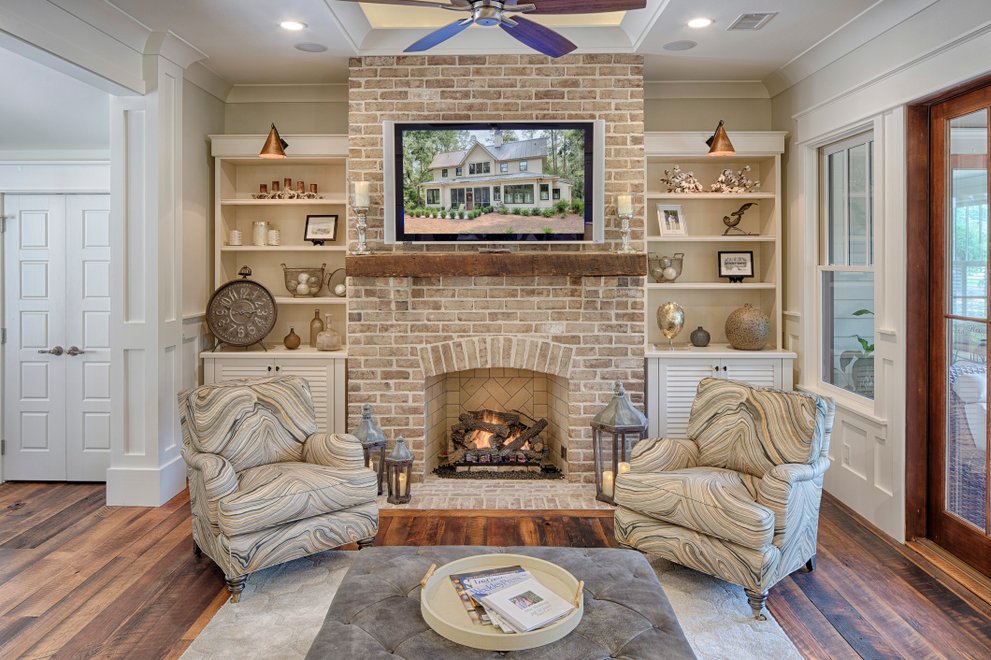


The 18th century brought not only the American Revolution but also a revolution in the way some fireplaces were constructed. Benjamin Thompson, known later as Count Rumford, redesigned the traditional deep fireplace to improve its output of heat and light. He recognized that heat radiates outward, and so built a fireplace with distinctive splayed sides, a tall firebox, and a shallow depth. This was different from the conventional way of constructing fireboxes, which were essentially cubes designed to hold the largest fire possible. Count Rumford also developed a narrow throat that permitted better draw up through the chimney, reducing soot buildup and improving the efficiency of the fire.
Rumford fireplaces are very common in England, because Rumford returned there during the American Revolution. But his designs endured in America as well. Thomas Jefferson employed Rumford-style fireplaces at Monticello. Many older fireplaces were later “Rumfordized” by raising the height of the lintel and adding additional brick within the firebox to create the shallow depth and splayed sides.
Today you can hire artisans who are certified to craft Rumford fireplaces. These are eligible, experienced masons who have taken a course and passed an exam. But a Rumford fireplace isn’t necessarily an expensive, labor-intensive venture. You can buy precast throats, dampers, and smoke chambers for site-built Rumford fireplaces, and some manufacturers sell prefabricated components that follow the Rumford design. One such company makes a kit of parts that interlock like toy bricks. Using a crane, a small team of carpenters can stack the pieces and build an entire Rumford fireplace and chimney in a day. Another company offers a steel framework that takes the guesswork out of constructing a Rumford firebox. With the frame in place, a mason can lay block and brick up against it for a perfectly proportioned fireplace.
Rumford fireplaces are very common in England, because Rumford returned there during the American Revolution. But his designs endured in America as well. Thomas Jefferson employed Rumford-style fireplaces at Monticello. Many older fireplaces were later “Rumfordized” by raising the height of the lintel and adding additional brick within the firebox to create the shallow depth and splayed sides.
Today you can hire artisans who are certified to craft Rumford fireplaces. These are eligible, experienced masons who have taken a course and passed an exam. But a Rumford fireplace isn’t necessarily an expensive, labor-intensive venture. You can buy precast throats, dampers, and smoke chambers for site-built Rumford fireplaces, and some manufacturers sell prefabricated components that follow the Rumford design. One such company makes a kit of parts that interlock like toy bricks. Using a crane, a small team of carpenters can stack the pieces and build an entire Rumford fireplace and chimney in a day. Another company offers a steel framework that takes the guesswork out of constructing a Rumford firebox. With the frame in place, a mason can lay block and brick up against it for a perfectly proportioned fireplace.